

each syllable a vertebrae: OFTHENOW Vol 1 No 9 (Dec 2025)
feat. four poems by Ace Chu; a conversation between spoken word poets Shivram Gopinath and Pooja Nansi; and Miss Mess’s Top Crushes of 2025
📌 MISS MESS’S BULLETIN BOARD
Chaos enthusiasts: we somehow made it through 2025 (okay, we’ve still got half a month to go, so let’s not jinx it), and what a voyage it’s been. It wouldn’t have been the same without all of you turning up for ✨ Miss Moi and the AFTERIMAGE ensemble ✨, throwing a little love into the madness and supporting local poetry. And speaking of supporting poetry…
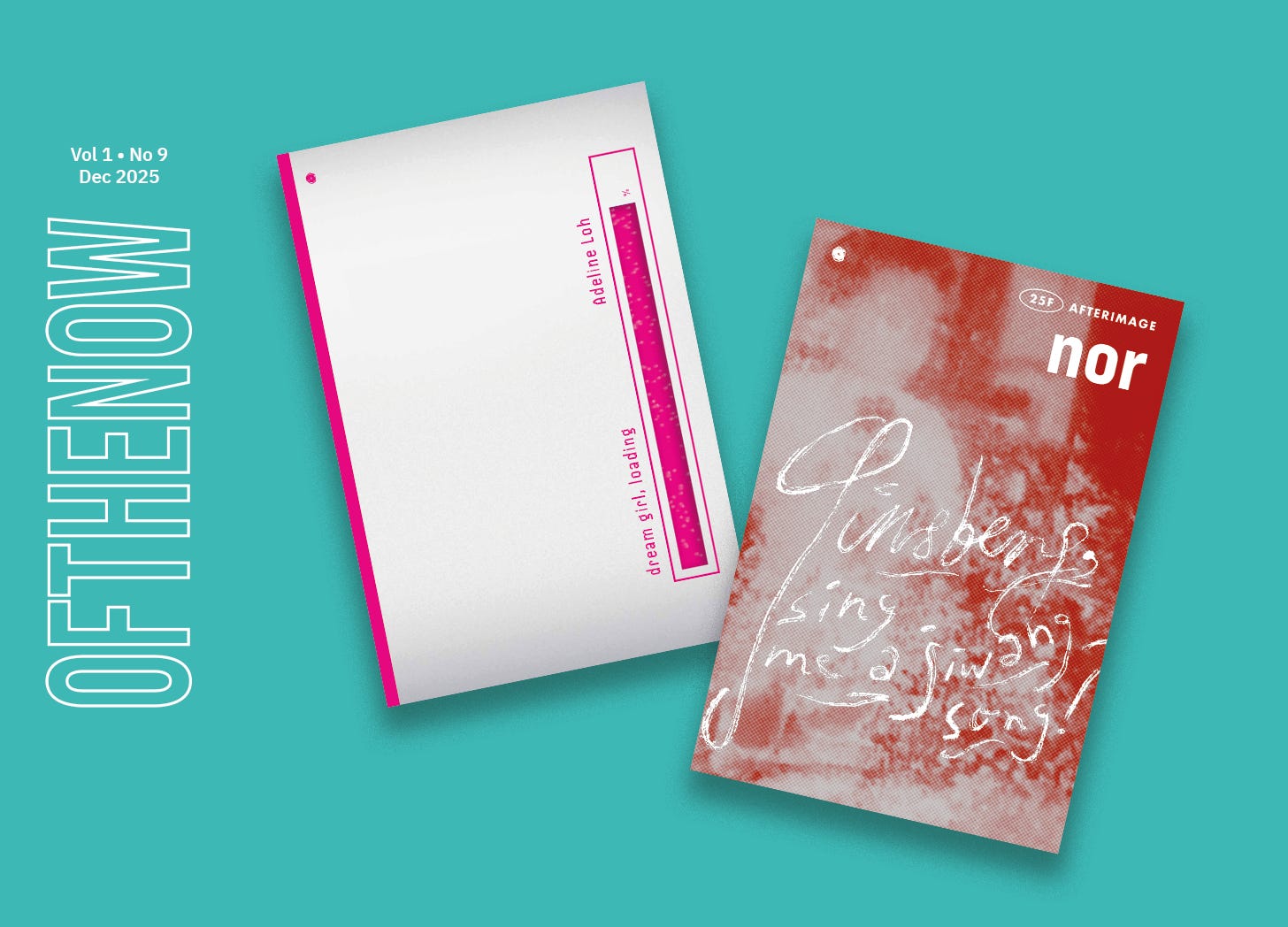
HOT OFF THE PRESSES AND READY FOR YOUR EAGER HANDS—our chapbooks are now available! These beauties are as wonderful behold as they are to read:
💖 dream girl, loading by Adeline Loh: Hit “START” on a new game. Think otome game where every choice feels like it’s make or break. That’s this chapbook. Poems leap across timelines, realities and “what-ifs”, hunting for happily ever afters and fantastical ways of being. Through all the messy endings and questionable choices, these poems show us how to own our decisions, and find meaning in the madness of it all.
🫀Ginsberg, sing me a jiwang song! by nor: Slice-of-life tumult, heartbreak, and never-gonna-love-again-but-kiss-me-hard-before-you-go energy, all in full technicolour. Opening with the soaring drama of 90s Malay rock ballads—karaoke rooms, military camps, bus interchanges—you’ll find the Beat Poets dragged into a new, wonderfully chaotic key.
The dust has (almost) settled on AFTERPARTY 2025: Chaos! Community! with AFTERIMAGE. Between spontaneous jiwang karaoke and spilled americanos, the chaos indeed revealed our community int all its messy, wonderful glory. We wouldn’t have it any other way. We couldn’t have asked for a better first year. Thank you for being part of it! 🥹
Before you roll your eyes thinking that Miss Mess has gone soft, hear me out: our fundraiser wasn’t just about printing poems or money—it’s about keeping local poetry alive. Your support literally powers more poetry, more chaos and more community. Every little bit keeps the poems coming, and amplifying the voices that deserve to be heard and seen. SO, throw a little love our way to fuel the chaos and keep poetry alive via our giving.sg campaign (psst… it’s tax-deductible hehe). 🤭 Fingers crossed for a holiday miracle… if it happens to be a buttload of love for our fundraiser, we won’t complain.
Finally, my paymasters would like to draw your attention to the BIGGEST and MOST PRESTIGIOUS award of the year: our 🏆Top Crushes of 2025🏆, an honour roll of groovy media, niche pastimes and hyper-specific obsessions that made us swoon and (ah! 🫦) feel something. (To check out our top reads of the year—be sure you’re following us on Instagram in the latter half of this month.) SO DON’T JUDGE:
2-hour deep dive videos on Medieval torture facts on YouTube
Attempting a cross-back straddle on aerial hammock
Brunöst 🧀
Dolmades <3
The Early Bird perk that comes with being an SGIFF Friend
Eclipse mints (in a pastel-coloured tin)
The lamb samosa at Cheeers on 456 Joo Chiatt Road
Smocks
“The Sofa” by Wolf Alice
A Toni Braxton revival in 2025 courtesy of Kayla Nicole
Wearing glasses again 🤓
Before we say au revoir for the year, remember ya: our limited edition chapbooks by Adeline Loh and nor are now available on our webstore. Spoil yourself! We’re sure they’ll make fabulous gifts. 😉
Yours crushingly,
Miss Mess
Official Spokesperson, AFTERIMAGE
🎙 LITERALLY, NO ONE ASKED BUT…
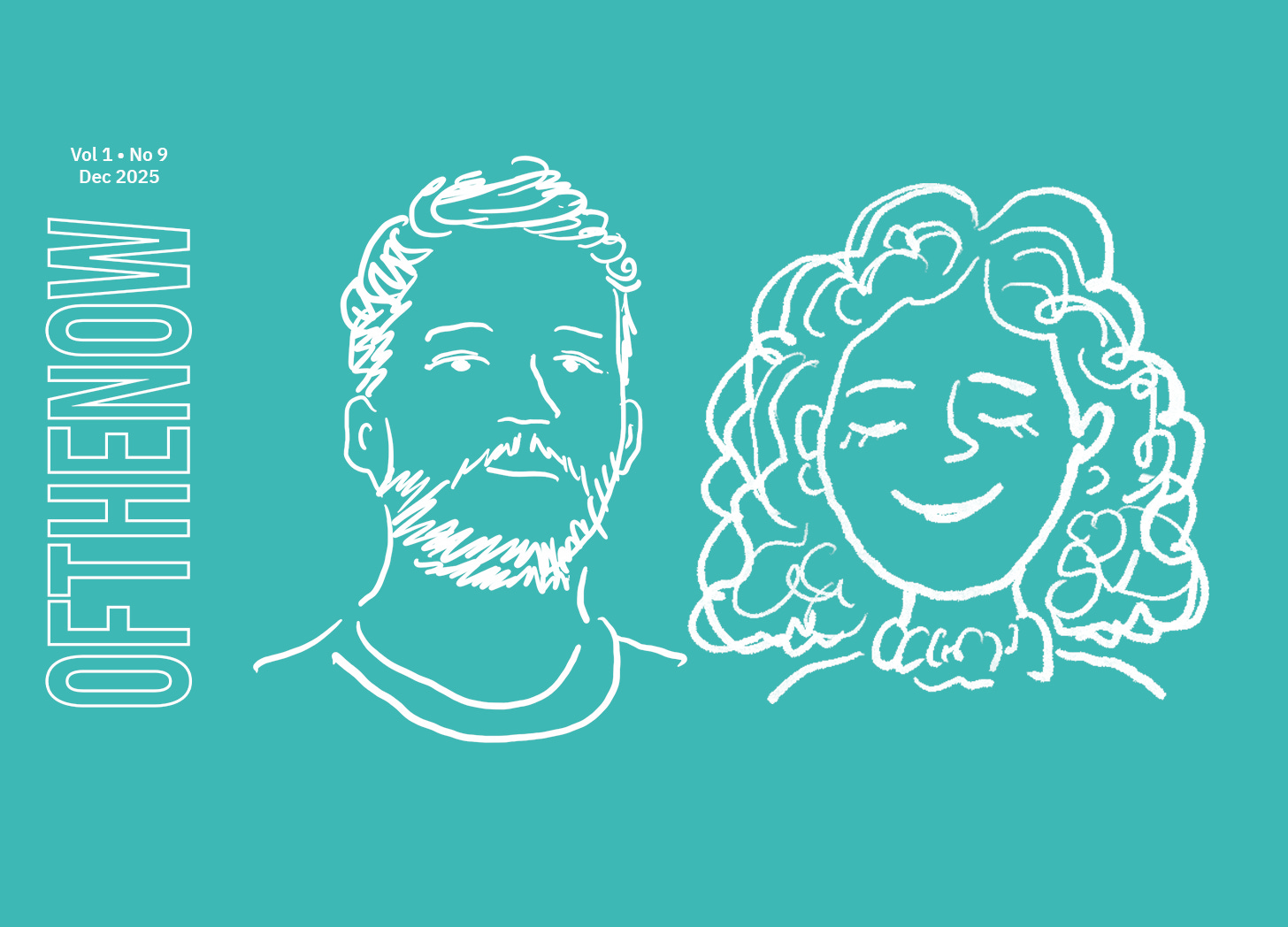
…the golden era of Singapore’s spoken word scene was in the mid-2010s. We said it! Recorded in the back of Behind The Green Door, literally an hour before rehearsal for We Make Spaces Divine feat. Dey, spoken word stalwarts Shivram Gopinath (of the aforementioned, newly-released Dey) and our very own Pooja Nansi spoke about the magic of collaboration, building a house within one’s manuscript, and the multitudes a masala movie can contain. As usual, their conversation has been condensed and edited for length and clarity, with its latter half made exclusive to AFTERIMAGE donors and OFTHENOW paid subscribers.
POOJA NANSI What are you listening to?
SHIVRAM GOPINATH I am listening to a lot of Tamil songs currently, in preparation for our show together… and also in preparation for the launch of my book, which is very Tamil movie-coded. So I am picking songs for both our performances and for me to get hyped up and into the mood. It’s a whole list of everything from 70s to now, songs by A.R. Rahman, songs by Ilaiyaraaja, and this, I think, less-celebrated music director who I really admire called Adithyan, also popular in the 80s. My soundtrack is full of Kollywood, basically.
PN So in a parallel world, actually for a couple of months now, just because we’ve been in the prep stage for We Make Spaces Divine ft. Dey—I’ve been listening to a lot of the remixes that Josh plays in rehearsals, just because it helps me think about how to deliver the poem and helps me live in the world of the show. So I’ve been listening to a real mix of like Kollywood and then like Bollywood, and then I kind of let my playlist do that randomised thing where they play the next song randomly? And so it’s led me back to discover some obscure 90s B-list Bollywood classics, which has been glorious.
SG (laughs)
PN So that’s kind of what I’ve been listening to a lot.
When we had our first in-person rehearsal, how did you leave feeling? And, like, what is the thing that surprised you?
SG Hmm. It was a—it was an ocean of emotions.
PN (laughs)
SG Y’all had already started rehearsing together, thankfully, so I felt like there was a bit of just adjusting and figuring out and catching up to do, which is natural, of course.
I always knew that this show was going to be a little bit bonkers. It is already quite, you know, substantial and rich with the way We Make Spaces Divine was first staged. But now with our Dey and We Make Spaces Divine worlds colliding, I knew it was going to be a little bit mad, but I think I left the rehearsal thinking it was madder than I could imagine, in the best way possible. And also, yeah, got me more excited to see how much madder we can make it? As long as our producer does not lose his shit.
PN He will lah.
SG (laughs)
PN I’m surprised that you thought it was bonkers actually. Because I think, for me, our books live in very similar worlds; same, same, but different.
SG Yes.
PN We have to shout out Isuru Wijesoma, who is the MVP of this show, because his music and the way he has thought through the soundscape of each poem has shaped the entire show. His brain is something else and I just adore it.
And I think what surprised me when we were putting the pieces together was how it went from the process of looking at Shiv’s poems and then looking at mine and then seeing how the poems speak to each other to seeing how each poem also has music to them. And it’s not just background music, right? Because the way Isuru works is to have the music add a whole other layer of text, such that the poems aren’t just in conversation with each other, the music is in conversation with the poems too. When we had our first meeting I felt like we were both going, oh my god, what do we do with all this material? But when we started shaping all that I realised, actually, that we write about so many similar things, but in completely different tonalities.
SG Yeah. I think we share the same worlds, but completely different universes? Or I don’t know, the other way around.
PN I feel like the lens is very different.
SG The lens is very different. And yeah, when I say “bonkers”, it is also in the arrangement of things. You will come into the show expecting certain things, but you are going to go away with the unexpected, which happened even with me. So that’s something I’m looking forward to performing.
PN It was unexpected for me also when you first came into the room, because obviously the energy shifts when the poems are actually read in your voice. That was quite wild. But then at the same time, I feel like it was exactly… it was what I thought it would be, but not? Because also, I feel like the reason I wanted to put the two works in conversation is also because when you talk about growing up Indian in Singapore, it’s like so fucking complicated. Right? And then it was also interesting for me to put those two worlds in conversation because I think for many of us, it’s not an isolated either / or. Like you don’t grow up only on Kollywood or only on Bollywood. You just don’t. Like that’s not possible.
SG I think, uh, living in Singapore as a brown person for most of my adult life—you keep uncovering layers of understanding of yourself, because the city gives you so much stimulus, which then puts your place in society in wonderful questions. You know? Many questions are raised without even words being uttered. Sometimes. Could be a look, could be a glance, could be just absurdities you observe—all of which needs an outlet, and sometimes it comes in the form of, you know, movies that maybe you find kinship with, music that you find solace in, and sometimes you end up writing books as an outlet, which I suppose is something we have in common.
PN I’m curious also about how long your book took? And I don’t mean that as a “why didn’t you write it faster” thing, because you took your time with it, right? I remember talking to you maybe in 2018, 2019 when you said you were putting a manuscript together, and then I would check in every time because I was just very excited. I was very excited that you were collecting all your material together into one space that just happened to be a book. What was it that took time?
SG Honestly, I seriously underestimated my ability to both be a writer and have a job in advertising, which was, um, you know, really, really killer. You don’t really expect how much space you need to write a book with a job like that. It is a sell-sell-sell, capitalist mindset that you have to work with, and you don’t get much time to do anything else. It was very high-pressure work, where the stakes constantly kept being artificially high, I would say, so I literally had to take time out. I did, like, a self-imposed writing residency where I went to Yogyakarta to just write, and most of my work was done in that one week where I didn’t have to think about anything else, really.
Then, uh, COVID-19 hit too, and though there was time to kind of reflect, there was honestly not much motivation to write, because it was a really weird—I don’t know if y’all recall—it was a fucking weird time, and there was no motivation to publish or do anything similar yet, cos I was trying to just figure out like what my life was going to be.
Plus, I got to say: a lot of these pieces got their start at spoken word places where you have to turn up on a date and time, so there was a deadline built in, and deadlines really, really help a writer like me. And when they were not there, different pressures and distractions happen. I have to take responsibility for my slowness as well. But I think things just take as much time as they need to, and, you know, ah—it’s here now. (laughs)
PN It’s here now. So good.
SG How long did you take to write We Make Spaces Divine?
PN It was coming up to six years between Love is an Empty Barstool and We Makes Spaces Divine. And like, I didn’t know what it wanted to be at first. It started with Mustafa Centre; I wanted to write a poem about Mustafa Centre just because Mustaq Ahmad’s immigration story so mirrored mine. And there are so many interesting things when you dig into his interviews and his archives that’s just ridiculous, because he’s done the literal thing of taking up space.
SG He’s built an empire of space.
PN He said: I will just fucking take up a road in the middle of the city. So if you talk about immigrants taking up space, that to me was very interesting because Mustafa is the size of a few football fields. And then of course there’s this thing I quote in the book, about the Prime Minister at the 2006 National Day Rally calling Mustaq “the right foreigner” because he created jobs, we need people like him, and the rhetoric was just like—that’s the frustration, right? Because he’s been here since he was 5 years old, like, the man doesn’t remember Uttar Pradesh; was selling handkerchiefs or something off his dad’s clothescart; decided basically, you know, bargaining is shit, we’re gonna just sell at fixed prices; builds this giant empire that at one point is selling cars in a shopping mall; and is still the right kind of foreigner, which implies a wrong kind of foreigner.
So it brought up all the usual questions about belonging. What do you need to do for this city to just see you as theirs? And then also: Do you need the city to see you as yours for you to feel like the city is yours? Like, do you know what I mean? Does the city have to claim you for you to claim the city?
But because I didn’t know what the book was about, a foolish version of me really thought I was going to write 50 poems about Mustafa, which obviously didn’t happen. But the book started becoming about these bigger questions of what is the centre, and what is its periphery—and then I just realised it was actually a lens thing, and I wondered what would happen if I wrote a whole book that just centered all the things that I love. That’s why it had a lot of these little pop culture references of very specific things like Lata Music Centre, which I remember as a child, and just very, very specific, sensorial things that made me feel grounded and rooted in this place, because I’m very much Singaporean? Like I have no complication about that, but obviously my experience of what it means to be Singaporean is specific to me.
And so I wrote the poems and I was like, I don’t know what this book is; I had like 60, 65 things that I just didn’t know what to make of. I don’t know what your process is—I know you worked a lot with Divya Victor—but my process is always to go to Joel Tan, who I trust with, like—if my writing was a life, I would throw it into his lifeboat each time, and he made me read every poem out loud to him as we finished a whole bottle of wine. I remember him going, well, okay, I know: these poems are about this, and this, and this, and this, which clarified the manuscript for me and guided how to shape it, and although that took a long time too I was really happy. It was a delightful time to just be with the work and I wasn’t anxious about putting it out.
A lot of my pieces start as spoken with pieces, and a lot of the editing happens in spoken word places. I’m wondering what that’s like for you?
SG Yeah, truly. Some of the poems in Dey are like 12, 13 years old? Including the first ones I ever attempted to write in order to perform? When I started putting them together in the form of a book, it was a series of, I suppose, epiphanies about form. The equivalent of having a Joel Tan and drinking a glass of wine and reading the poems aloud for me was just taking time off just to see what did these things mean? I mean, I had the same questions, like: What do they all mean? What are these things? And if you don’t know what they are, how do you build on them? At least these were the questions to myself.
So I would say the first point of inspiration I suppose, was—yes, I am so influenced by movies, and so is Dey. Specifically Tamil movies. I’ve also seen Singapore kind of always operate in this kind of filmic, repeated, trope-y patterns? Where every year there is a news article about a kindhearted migrant worker, without fail, you know? And then there is the typical, you know—the otters will go and do something and everyone will be like, oh, adorable or like, oh, no? These kind of things just kept repeating as patterns and made me think of, you know, the tropes of Tamil cinema where also, there is the mother sentiment and the heroine always getting teased by the hero, and eventually, you know—
PN Eve-teasing.
SG —eve-teasing as a token of love, you know?
PN So problematic. (laughs)
SG Yes, very yes. A lot of these tropes are very, very problematic. As are patterns that you’ve seen in Singapore, right?
PN One hundred per cent.
SG I mean, there are great things and there are bad things. So that kind of understanding, of structure that I could adopt, gave me more freedom.
PN Right. So then when you got to the spine of the thing, you were like, oh, I can build it like that.
SG Yes, I know how to build now.
Another sort of forced epiphany came from my editor, Divya, who we were working with remotely because she’s based in Michigan, and I was in Singapore then. And to paraphrase one of the things that she told me, during maybe an early draft of Dey that she was reviewing, was: it seems like you have built a house, but you are only staying in the bedroom. Please go and see the toilet and the kitchen and the balcony and everything. And yeah, these kind of words were quite magical for me to see how else I could contribute to the thing that I was building.
That actually made me write in Romanised Tamil. I started drawing from the observation that, okay, if this language, English, is playing truant, where else can I draw from? Let me try and extend my arms as wide as possible. Then I started very much with a lot of fear writing in Tamil to see where that takes me to, you know? So I wouldn’t claim to say that these poems are, you know, the pinnacle of Tamil literature, but they were—
PN (laughs) WHY NOT?
SG You will read and you will find out. No, but really they were an outlet for me, to understand ways in which I think, and I think very differently when I think in English, and I think very differently when I think in Tamil. And maybe you shouldn’t get so used to thinking in English if there are other ways of thinking too? It’s a way of decolonising your mind? It’s a way of cleansing your memories? To see what has remained, and where else you can draw from. So I think these were two points where I saw the book really grow from imagination to, like, coming to life. (to be continued below)
✏️ BIG POET ENERGY
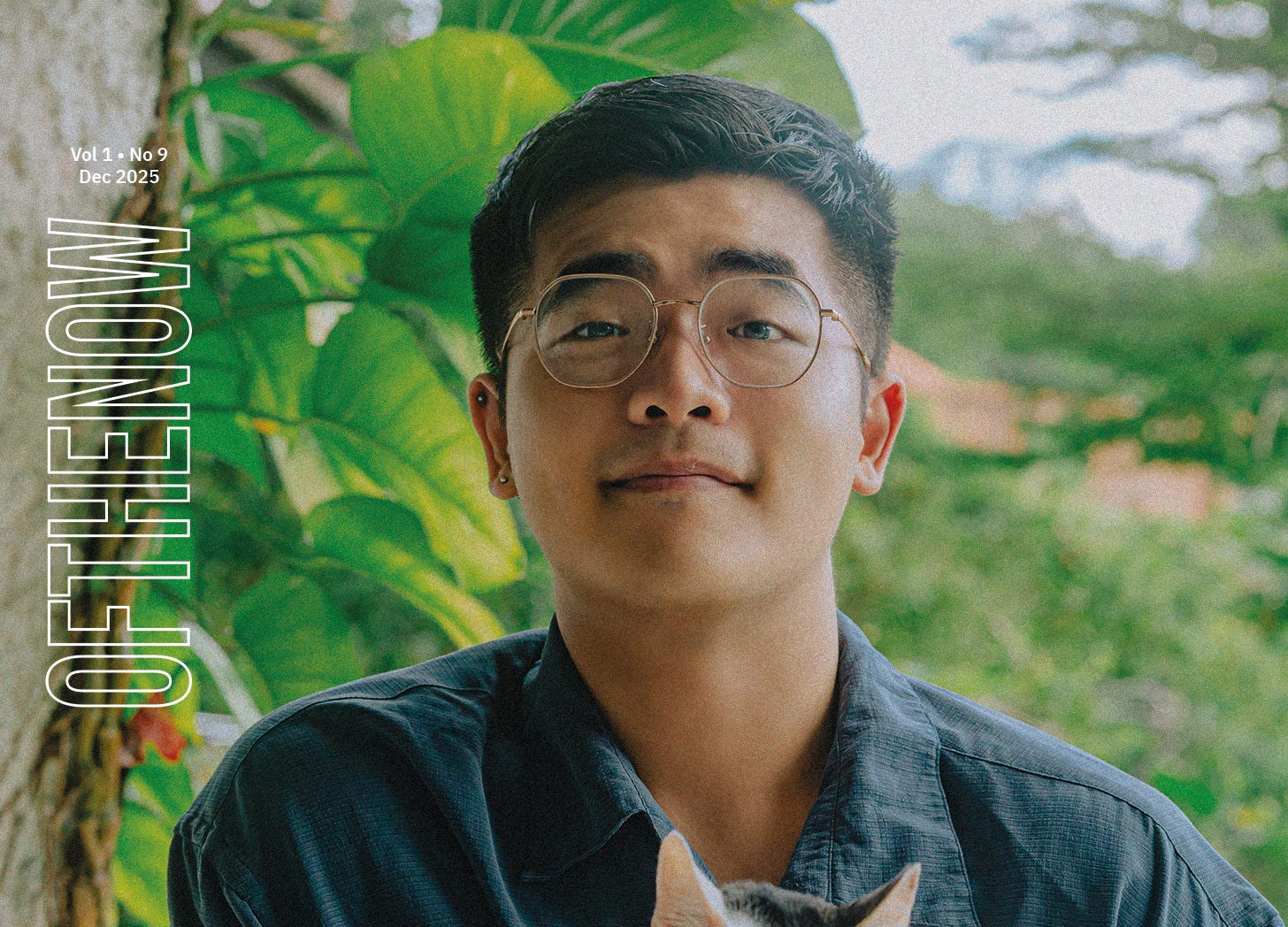
Ace Chu (b. 1999) is a writer from Singapore. His recent work can be found in places like Quarterly Literary Review Singapore, Pithead Chapel, and Tiger Moth Review. Look for him at acechu.com.
His poems in OFTHENOW Vol 1 No 9 (Dec 2025) are: “There is the Dark”, “Coming of Age, “Bugs I Remember” and “Cicada”.
