

folding paper for days: OFTHENOW Vol 1 No 10 (Jan 2026)
feat. a poem by Abigail Xiaoxuan Chen; a conversation between poet-editors Daryl Lim Wei Jie and Tse Hao Guang; and The Miss Mess Award for Psychological Warfare Disguised as Renewal

📌 MISS MESS’S BULLETIN BOARD
Dear 2025 survivors: Miss Mess is reporting for duty, dragging a confetti cannon behind me and screaming 🎉NEW YEAR, NEW ME 🎉 into the void. Hold on to something, because 2026 is getting crazier. The Messmen are back, limbering up and plotting with capital “I” Intent. And the vibes are suspiciously hopeful? Or… ominous? We will not be clarifying any further. Thank you. ✋
We’re starting the new year with a little tease. 😉 A new ALLTHETIME folio is dropping in February; let’s just say there will be blood... 🩸😏
While you wait for more details, may we gently (aggressively) suggest you do your homework, if you haven’t yet, with our first ALLTHETIME folio, rib/cage? Think of it as a warm-up for your little noggins and your hearts. Co-authored by Rosaly Puthucheary, ArunDitha and Zeha, rib/cage unearths words carved into verse as sharp as bone, shattering the suffocating grip of silence and constraint. And let me tell you, this is just a taste.
💸 KEEP THE LIGHTS ON: Toss a coin in the AFTERIMAGE fountain, please. Small presses like us require a little more than applause and praise to survive. If you believe in our mischief and mission of rendering the country’s literary lineage anew, we would be over the moon to have your support in our ongoing fundraising campaign. We promise to live up to your trust, your faith and your ✨impeccable taste✨😚
Thought this year’s Golden Globes were predictable? Eagerly anticipating what they might mean for your 2026 Academy Award predictions? Guess what: EVERY MONTH IS AWARD SEASON IN THIS HOUSE. In the solemn category of Psychological Warfare Disguised As Renewal, our nominees for this month’s Miss Mess Award included: 📒 The Brand New Planner—pristine, overqualified, now abandoned like a failed situationship; 🥗 “I’ll Cook More” January, for lasting precisely one grocery run and a single ambitious salad; 🧠 The Personality Upgrade: loudly announced, quietly, rolled back without notice; and 🇺🇸Donald Trump! For ACTUAL warfare. However, the winner does ultimately have to go to:
🏆January🏆, for showing up like a LinkedIn thought leader with a whistle, a vision board, and absolutely no warmth. Her official citation: “January arrived carrying a ring light and the phrase ‘new year, new me’—then immediately asked us to account for our sleep schedules, spending habits, unresolved trauma, and five-year plans. Talk about violence without any foreplay. January came in acting like your most annoying friend who’s suddenly into wellness, asking if you’ve thought about your goals, casually dropping words like ‘alignment’ and ‘intentionality’, then watching—silently, smugly—as everything you swore you’d change began to crumble by mid-month. No judgement, she said. Just curiosity. Deep, terrifying curiosity.”
As her prize, January will receive: 🪞 a mirror that says “be honest” every time you pass it; 📉 a dashboard titled “Expectations vs. Capacity”; and 🕯️ a candle called Eau de Accountability, with notes of citrus, dread, and late capitalism. Because nothing says personal growth like realising the year is long, the systems are rigged, and you are still fundamentally yourself. Yes.
That’s all (for now). February is waiting in the wings—shorter, meaner, and refusing to pretend it’s a fresh start. Help us clear (expectation) our 2025 stock in the meantime by perusing our webstore (capacity). We’re begging you!
Yours in mild disillusionment,
Miss Mess
Official Spokesperson, AFTERIMAGE
🎙 LITERALLY, NO ONE ASKED BUT…
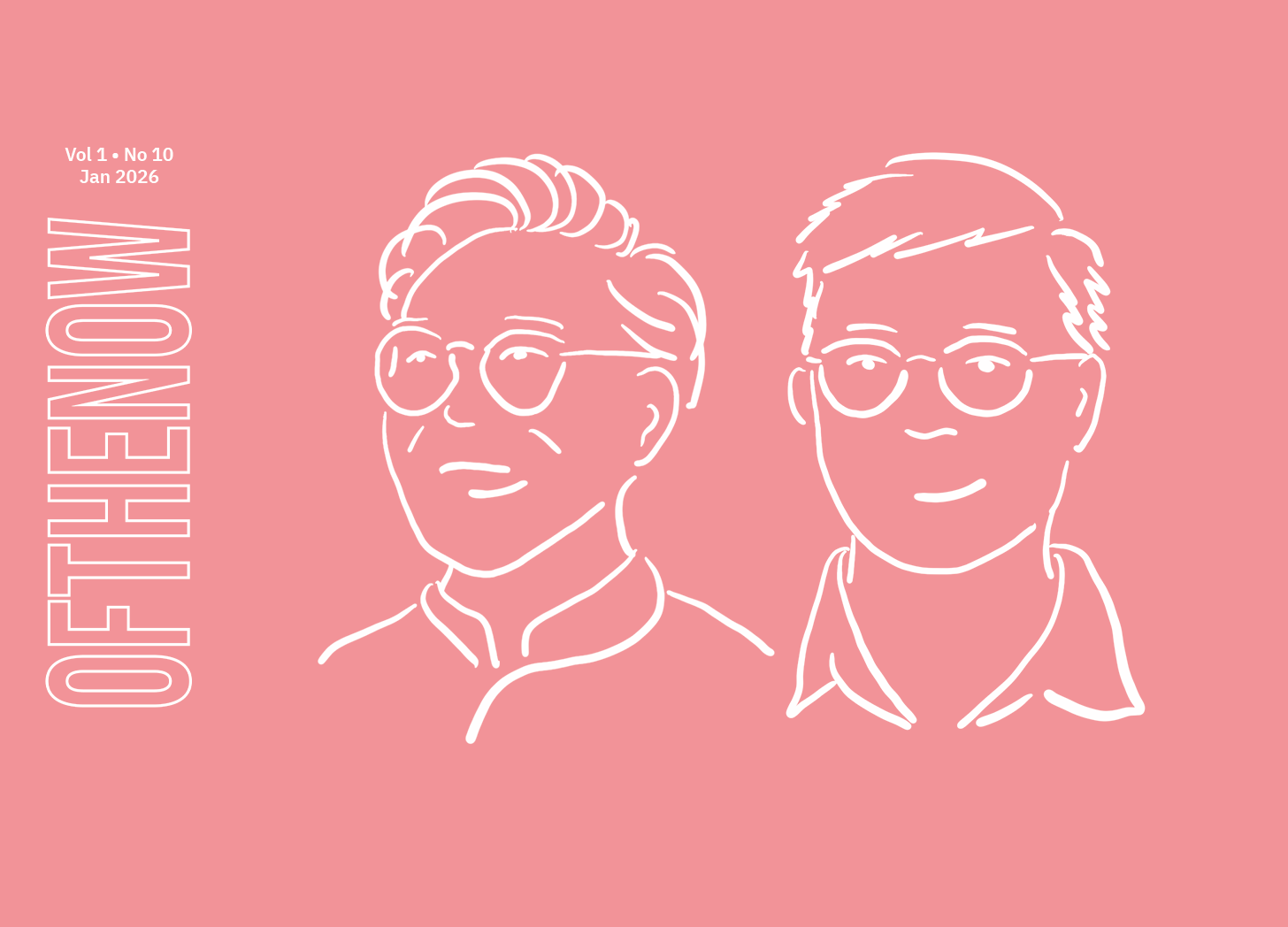
…everybody does poetry, whether they realise it or not. Recorded at the Old Chang Kee situated at the NLB Plaza, the poets / editors / serial anthologists / experimenters / frequent collaborators Daryl Lim Wei Jie and Tse Hao Guang spoke about finding text on Hardware Zone, the perennial question of writing in English(es), and being in a quote-unquote “promotional phase”. As usual, their conversation has been condensed and edited for length and clarity, with its latter half made exclusive to AFTERIMAGE donors and OFTHENOW paid subscribers.
TSE HAO GUANG What are you reading at the moment?
DARYL LIM WEI JIE I am taking advantage of the Kinokuniya end-year sale, so I’ve just bought 3 books. One of them is by the nature poet Wendell Berry, who I hadn’t really encountered before, but I’m really surprised by his lyric and the way he talks about nature in a very innocent and kind of uncomplicated way, which I think is interesting to me, because I feel like we can’t talk about nature in such an uncomplicated and unsullied way now. What about you?
THG I’ve been a bit tired of American poetry. So recently I’ve been reading some Southeast Asian poetry, like Mikael Johani’s Mongrel Kampung, which is great. I’m also reading this book of essays by Yoko Tawada, Exophony: Voyages Outside the Mother Tongue, and I love this book—
DLWJ (nods enthusiastically)
THG Yes, you’ve read it right. I love it because it’s actually translated from Japanese, and she’s addressing Japanese people, but she also talks a lot about the structure of language and languages and how they are similar or different, and how she sort of exists outside of any particular language. That’s the best way I can describe it.
DLWJ Yeah, I’ve read that book too. It was kind of inspirational? And quite hard to grasp, because I think she’s like no other writer that I know in the way she really works in between languages. So she works between, I think, Japanese, German and she kind of just writes in both? Sometimes she writes one text with Japanese first and then some in German first, and then I can’t remember if she translates her own stuff—maybe not, actually—and people like that fascinate me. This goes back to people like Nabakov, of course, who grew up speaking Russian, but many say wrote so much better in English; Jhumpa Lahiri, who writes in Italian—all these people who use another language to inhabit another skin and another voice. I think that that’s pretty intriguing.
THG I think, in many ways, the writers in our part of the world are largely like that, especially those who came from an older generation. So Wong May, of course; I think Wong Phui Nam probably, yeah. I feel like a lot of the ways in which they are innovative, strange and interesting come from the fact that they came to the language they write in later on, right? And so other languages have already infected or inflected the way that they think about English and whatever language they might write in.
DLWJ Brandon Liew and I worked on this new, posthumous collection of poems by Wong Phui Nam (In the Mirror: New and Selected Poems of Wong Phui Nam), who’s a Malaysian poet. And in some ways, much of the book—if you read the kind of prefatory material, the surrounding text—is occupied with the question of: why am I writing in English? Because that’s the question a lot of them in the 1950s and 60s had to answer. Because they were a minority, a super minority, kind of the people who were educated in English, in Singapore and Malaysia, and Malaya. Why were they even bothering to write in this language? And what did it mean to write in this language, but not be white people? That’s kind of the answer. And this whole book is kind of an answer to that question.
THG I think the question goes even beyond “why write in English if you’re not a white person”, because it’s also “why write English in a part of the world that is not the UK, the US and Australia”. Part of it is colonialism, but also part of it is reclaiming something in that, in colonialism itself, for yourself, I feel. So there is a very personal aspect to it as well. It’s not just that I want to reach the white publishers, you know, and be very famous. And of course I wrestle with this question too. I mean, I think in some ways—I don’t wanna be prescriptive—but I feel like if you do not wrestle with this question, you still have some way to grow as a writer, and especially in this part of the world, certainly, right? Like, I feel like you need to wrestle with this question, and I wrestled with it a lot.
I think part of the wrestling produced this, I guess, rather old (by now) anthology called Unfree Verse, which is a book of poetry that is full of formal poetry written in English, and the forms are also often Western forms. And so I wrote something in there about, you know, dealing with how to both repeat, but also repudiate colonial histories? And I think that is sort of an ongoing struggle that takes many manifestations lah, yeah. So I do think we need to understand why we write and why we write in the languages we do—not just the styles or the influences.
DLWJ I think if you didn’t have something to add to the English language from our position, meaning people who are sort of still, in some ways, peripheral to the centres of Anglophone production—so not in London, not in New York, not even in Melbourne—you must have something urgent to say to those centres. So I think that’s where we are at.
I think some of the responsibility, in my case, takes the form of translation. I’ve translated the work of Singaporean Chinese poet Wang Mun Kiat (Short Tongue 短舌 (Bilingual Edition)), and I’m also in the midst of translating another Singaporean Chinese writer, and it’s out of this sense that you have something to say to people who you think others should be listening to. It drives a lot of the things that I’m doing. To go back to the Wong Phui Nam book, there’s this sense that there’s something going on here, in Malaya, that was different from what was going on in London, in New York, in Melbourne—there’s something different that’s going on in Southeast Asia that I feel like needs to be brought up.
THG I have a question about your translation. There’s an interesting dynamic in translating anything into English, because the translator tends to have a certain amount of power in opening up writers who don’t write in English to the Anglophone market, which also tends towards the centres of Anglophone literary production. Do you feel that the way you are translating, or the avenues through which you’re translating, speaks to those centres, or engage in some kind of reflection or dialogue with them?
DLWJ This is now very serious. (laughs) But the publisher I’ve chosen to work with is TrendLit, and the great thing about them is that they are based in Singapore, and they try to, I think, largely reflect or find writers from Singapore and Southeast Asia. And I think they are trying to sell, when in translation, to an Anglophone Singaporean audience. So there’s kind of that, I think, very important bond between the languages in Singapore that has actually fallen off the radar a little bit; and there’s a thinking about reading other Singaporeans in their languages, rather than just people from China or Taiwan, and it’s kind of easy to forget that there’s this whole centre of Singaporean Chinese literature that’s slowly coming out.
So I’m very excited that Jeremy Tiang has translated Yeng Pway Ngon’s book (The Colour of Twilight), which is coming out in January, and I think that that work is important, and kind of why I’ve chosen to mostly focus on Singaporean Chinese authors. Although there’s nothing wrong with other Chinese authors, I feel like Singaporean Chinese authors are the ones who often get left out of the conversation, because they are not not Taiwanese, they’re not Chinese, they’re not from Hong Kong. People forget that actually people here also write in Chinese.
THG I’m asking my question because it’s frustrating to feel like the only kind of writing, or the kinds of writing that matter most, are the kinds that these larger publishers would be interested in. So whether it’s genre, whether it’s style, we celebrate when a Singapore writer, finally, you know, publishes a book in the US, we celebrate when Jeremy Tiang brings out a book of translation in the US or the UK, but at the same time, I feel like there’s still that dynamic, right, that is oriented towards the centre. What I’m saying is I don’t really have a good answer to the question lor, that’s why I ask you.
DLWJ I mean, I have no solution to it as well. I feel like we can’t be purist about it—we can’t say, oh, I only publish with Southeast Asian presses. And if a big opportunity came up with a New York press or something, I think I would be lying if I said I wouldn’t take it up. So I guess we just do the work that we have to do to advance the causes that we are keen to advance.
I’m surprised you didn’t talk about Eat Drink Man Woman in talking about Englishes, actually. So maybe this is a good time for you to talk about it.
THG EDMW—or Eat-Drink-Man-Woman, as many of y’all might know—is a sub-forum in HardwareZone, and it is where people come and chitchat, gossip, argue, curse, et cetera, and the kind of English—even the kind of Singlish that goes on there—is actually quite stylish and innovative? And very interesting, I feel. So me and my collaborator Max Ho have been, for a couple of years now, uh, finding poetry from those forums. Max is the forum native, while I’m really just looking in as an anthropologist, and Max has given me all these wonderful screenshots from EDMW, and we have been working together to collage them into poems.
You know, really, the funny thing is, I had assumed these poems would be unpublishable anywhere outside of this region, simply because of the nature of it, right? The English is unrecognisable to anyone else. But the weird thing is, I think the Singaporean outlets have not been very interested in it, and then the people who have been interested in it are, like, white women from the UK, a Dutch publisher who is kind of interested to bring it out—I’m frankly shocked. I do not know how to explain this. All I can say is maybe there’s a bit of a cultural cringe in Singapore about this forum and, you know, too many associations with it that make it feel like it’s not suitable? And I suppose the style of it, if you just look at it, is quite different from contemporary Singapore poetry, so maybe that’s why it’s being rejected.
DLWJ I have to say, I’m very proud that I’m one of the first people to have published the EDMW poems, because in a book I did two years ago called The Second Link: An Anthology of Malaysian & Singaporean Writing—we published some of Hao Guang’s poems from this series, specifically about Singaporeans commenting on Malaysia and vice versa, I think. And I would say that when Hao Guang read them out at the launch, I thought the reception was really good. But it’s interesting how it has landed.
In some ways, you and I have led weirdly parallel lives. We both have sort of written—not as much as you or Max might have—but some of my early poems were also drawn from EDMW language, and it was a phenomenon that I was quite intrigued by.
The other thing that you and I did was also to experiment with large language model-ish things to sort of generate text. You did your experiments chronologically earlier than I did, but we just launched our books together last month: his (White Dust from Mongolia) uses LLMs, mine also to some extent, and I feel like the reception to them have been much more enthusiastic outside of Singapore, at least from my point of view, than within Singapore. And also they don’t function as ordinary poetry books—Mistranslations from a Future Vernancular is positioned more as an art book, and I feel like the audience it has gotten, and the questions it has gotten, come less directly from folks in poetry, but from people interested in conceptual art, visual design, that sort of thing. I feel like I’m sort of in a genre-bending phase, or a mode-bending phase.
THG I hadn’t really thought about the Eat Drink Man Woman poems and the LLM poems together, but now that you have linked it, I feel like part of why I wrote them had to do with a decentering of the ego in writing, and it doesn’t need to happen with like found poetry or or LLMs; it can even function through things like automatic writing or fiction, in the way you put yourself in the headspace of a character that’s not like you at all and then you write from there. I think that a lot of Singapore poetry is still quite egocentric and and I say egocentric with a neutral value associated with it, right? Egocentric in the sense that there’s something very deep within a person and they want to express it, rather than placing yourself in the shoes of another person or allowing another thing or person to affect the way that you write.
And so consider White Dust From Mongolia, a pamphlet almost completely written with an open-source LLM in 2021, when I was struggling to end The International Left-Hand Calligraphy Association. I had been, and continue to be, obsessed by writers who stop writing or publishing for whatever reason, and the extreme case is Korean-American artist and poet Theresa Hak Kyung Cha, who released a monumental book Dictée and one week after was brutally raped and murdered. I realised I had been mourning her in a very particular way, even though I have no personal connection to her right? But I do deeply wonder what writing and the larger world has lost with her death. I took the title of an unfinished film of hers (which is the title of the pamphlet) and got GPT-J to autocomplete it over and over hundreds of times, selecting from those generations where I found the language strange, subtly sad, filmic. It took so much more time than writing by hand. Today’s models are “too good” to make poetry. GPT-J is also obsolete today, and in a way I feel the book now mourns both Cha and the model.
I should say that having done all these things for a few years now, I’m a bit tired of this ego-less way of writing. I want to go back to ecocentrism? (laughs) I think it’s part of a cycle. When I was writing that previous full-length collection, there was still a lot of me in it, and I did do automatic writing and blah blah blah, but I still feel that it was very lyrical in that sense. So I was like, oh, I need to get out of this, I need to do something different, and that was how Eat Drink Man Woman began; but now, having leaned into EDMW so much, I’m also tired of it, and feel like I need to go back. It’s a bit yin-yang or whatever. I feel like that ties it together. (to be continued below)
✏️ BIG POET ENERGY
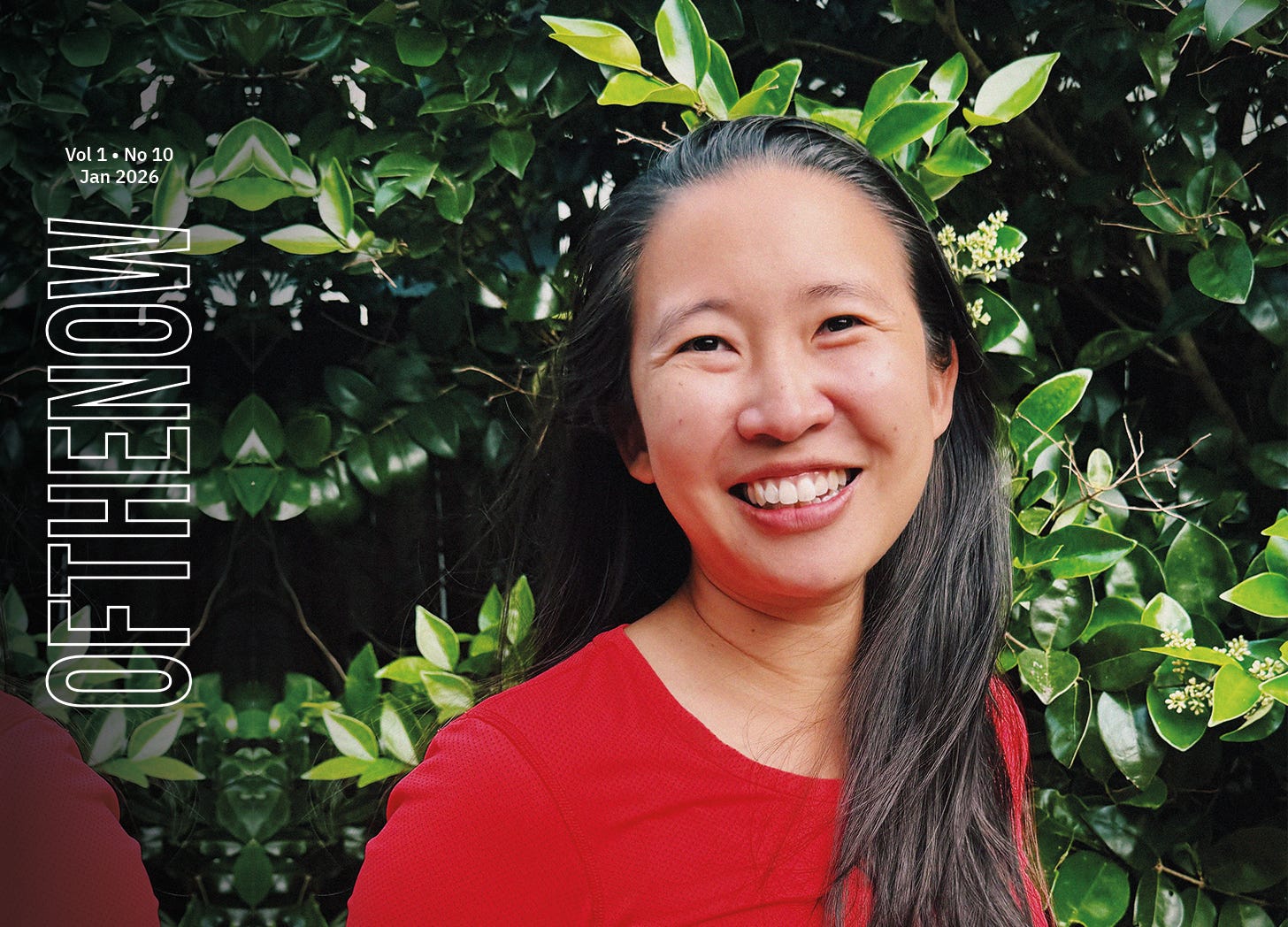
Born in Singapore, Abigail Xiaoxuan Chen (b. 1988) lived abroad for significant portions of her life before settling down in Taipei, Taiwan. When she isn’t running after her toddler or grading essays, she can be found knitting.
Her poem in OFTHENOW Vol 1 No 10 (Jan 2026) is: “despite everything, spring is still her favourite season”.
