

our yet unlived lives: OFTHENOW Vol 1 No 4 (Jul 2025)
feat. a poem by Valen Lim; a conversation between memoirist Shze-Hui Tjoa and novelist Daryl Qilin Yam; and the Miss Mess Medallion for Distinguished Act (tank u, next)
📌 MISS MESS’S BULLETIN BOARD
Guess who’s back, slick with sweat and clutching their kopi bing like a life raft…… Miss Mess here but barely surviving this fever dream of the past four weeks. I’ve sweated through three outfits already and I’m one poem away from total evaporation in this (figurative and literal) HEAT. LET’S GO. 🔥
What God Took Your Legs Away launched this month and it was nothing short of fire. Wahid was joined by Dr Paul Tambyah (yes, that one) in conversation with (my one and only) Pooja Nansi. Together, they explored the cost and courage it takes to put oneself unapologetically forward. Full was the house and our hearts. Thank you for showing up, sitting with it all and holding space for the work. 🥹 The book’s out now—get it and let it (lovingly) haunt you.
If you have FOMO, don’t worry—we gotchu:
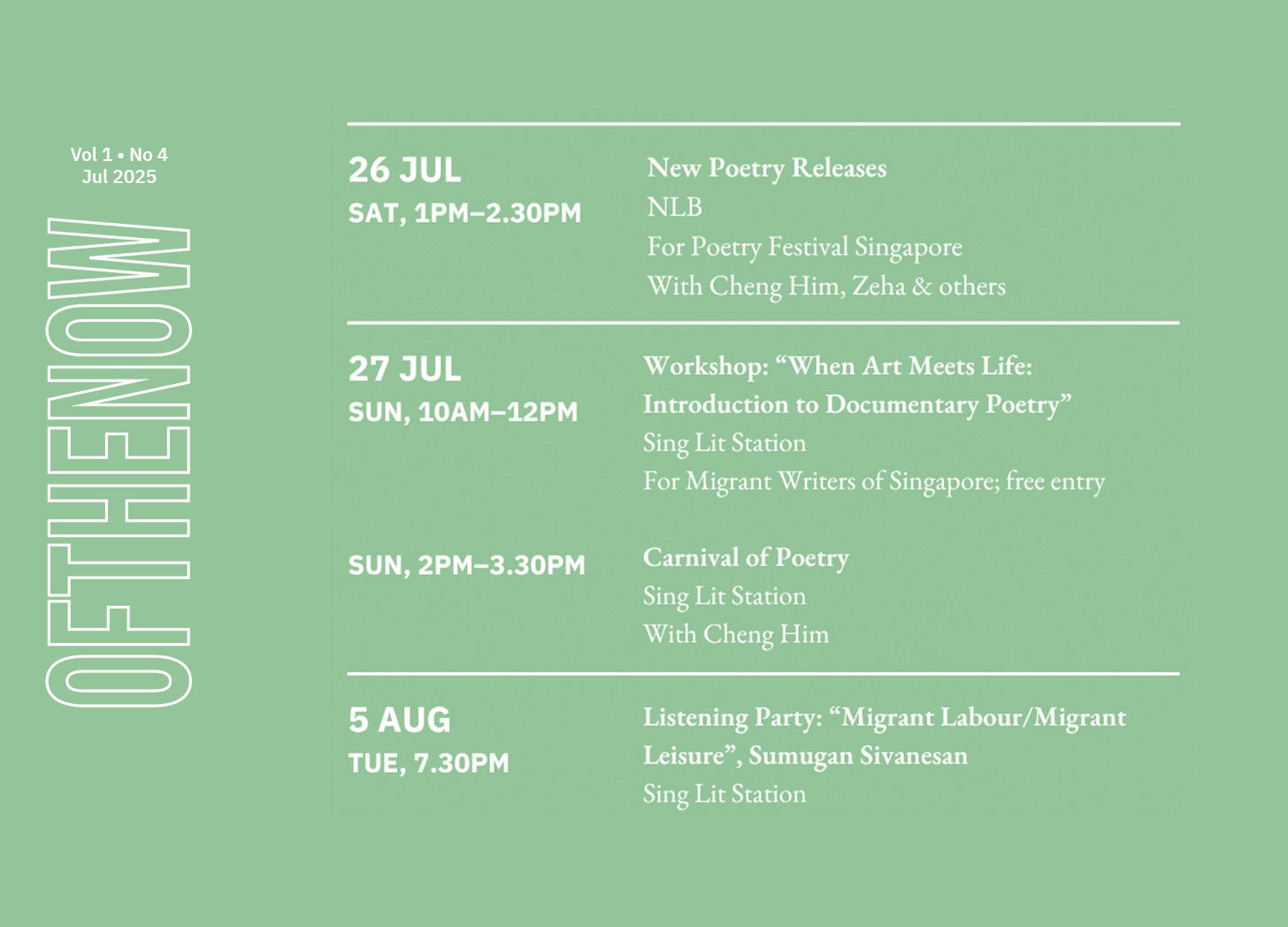
Poetry Festival Singapore: New Poetry Releases Reading (26 Jul, 1pm, NLB Imagination Room): Singapore’s poetry scene is heating up, and Wahid, Cheng Him, Zeha, and others are here to turn up the heat with fresh new voices.
Migrant Writers Workshop: “When Art Meets Life: Introduction to Documentary Poetry” (27 July, 10am, Sing Lit Station, free admission): This workshop is exactly what it sounds like. Wahid dives straight into the blazing, messy heart of documentary poetry. Prepare for burning honesty.
Carnival of Poetry (27 July, 2pm, Sing Lit Station): Carnival of Poetry is a multi-lingual celebration of verse led by migrant writers and artists in Singapore. In July’s edition, the circle of life unfolds in many tongues, with Wahid and Cheng Him taking the lead.
Yup, we’re still in our sugarbaby era. 🧚🫶 Publishing poetry is a labour of love (and many, many dollars). Every bit of support helps us continue building a poetry press that cares about the work, the people behind it and the readers who need it. Contribute to our giving.sg campaign or we might have to start an 🌶️OnlyPress🌶️ account; only got exclusive spicy printer tantrums and saucy existential crises. Don’t get this wrong: THIS IS A THREAT. (Support!!)

This month’s Miss Mess Award is a special one. We hereby bestow our first ever 🏆Miss Mess Medallion for Distinguished Act🏆on the Leopard tank that treated a traffic light like a polite suggestion and absolutely bodied it on North Bridge Road during an NDP rehearsal. We’re not saying NDP prep doesn’t require precision and might, but maybe we don’t need to demonstrate state power by flattening public infrastructure. Especially not in front of impressionable kids at a National Education show. Still, we salute the commitment to drama—because what’s an NE show without a little chaos, a little clang, a little “did anyone get that on video?” No injuries, no casualties… unless you count that poor traffic light and our collective sense of civil order.
The heat’s still cranked to the max and our plans are still sizzling like a wok. Sleep on our Instagram and you’ll be stuck sweating alone in the dark; SWEAT SOLO OR STAY WOKE.
Tank u to thank u,
Miss Mess
Official Spokesperson, AFTERIMAGE
🎙 LITERALLY, NO ONE ASKED BUT…
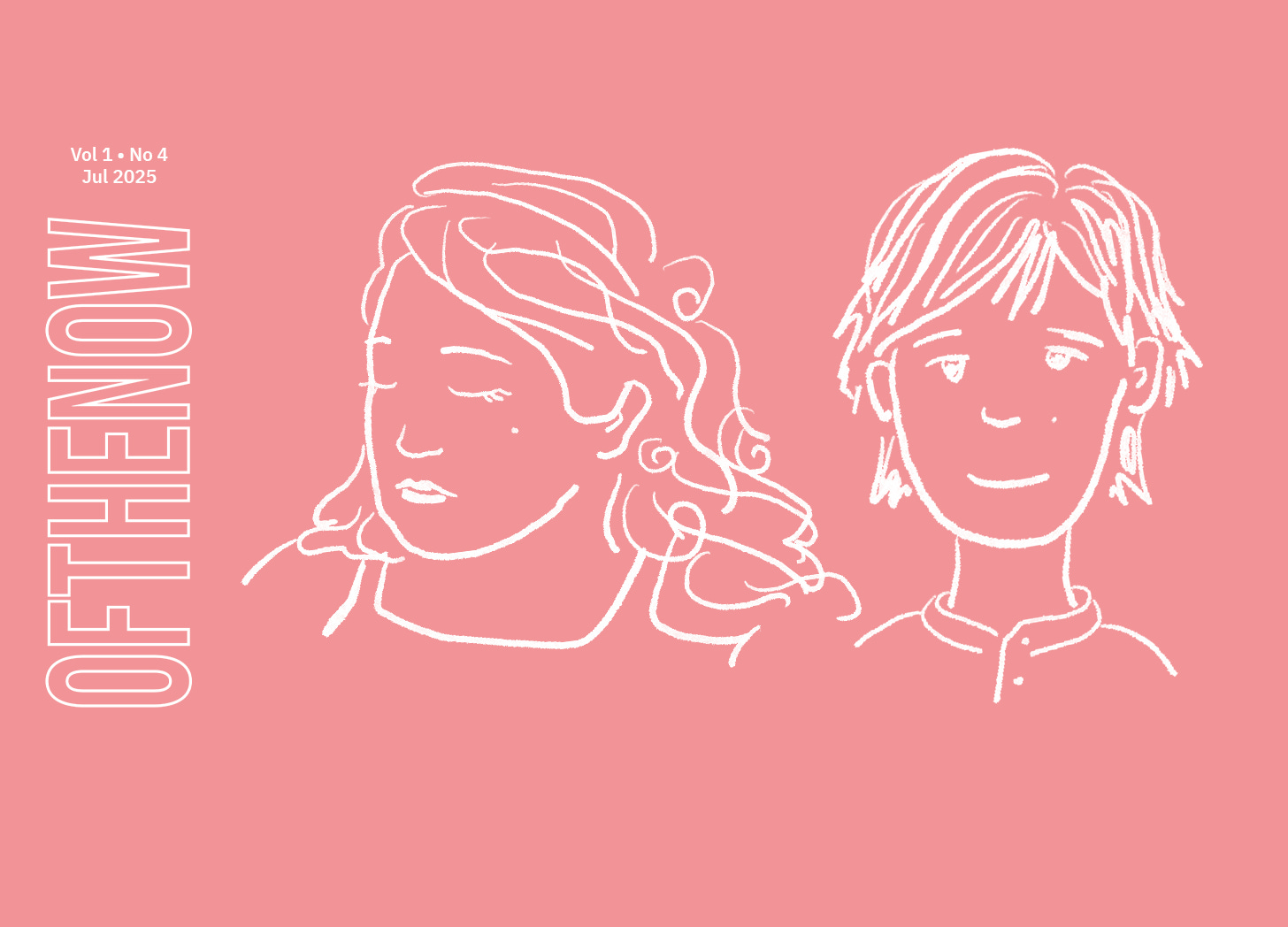
…this is a very earnest chat between Shze-Hui Tjoa (author of The Story Game, whose Southeast Asian edition is out now with Faction Press) and our very own Daryl Qilin Yam. Speaking to one another via missives on a shared Google Doc, this conversation on craft is all about the misadventures that went into the making of their latest books; as usual, the latter half is made exclusive to AFTERIMAGE donors and OFTHENOW paid subscribers.
SHZE-HUI TJOA I feel like this conversation is catching me at a very specific transitional moment as an artist.
DARYL QILIN YAM How so?
SHT Hmm… having published my first book and now trying to write my second, I feel like a new version of my life is just beginning while the old one is, in some ways, disappearing around the corner.
DQY You know, when I first published Kappa Quartet, back in 2016, I’d feel quite appalled and afraid whenever a person told me they’d read it. Looking back I realised that the book wasn’t just a book for me, but a little container I poured the ugliest, saddest parts of myself into. Was that healthy? I don’t know, and I don’t think I really care. Even now I can’t reconcile the author that willingly did that, with the author that literally ran away from his readers. Because the author I am now nine years later is quite different, I’d say. I’ve gotten better used to being in the light.
SHT Something I found very striking in Be Your Own Bae was how you used elision. There were moments where one character would ask an emotionally significant question and the other would avoid it—so that the answer also slipped away and left me suspended in curiosity. Can you say a little about the elision in your work? I’m wondering how you came upon it as a craft technique—was it about preserving a sense of mystery, or something else?
DQY I get why the use of elisions might have struck you as productive—The Story Game understands that literary experiences tend to operate like mysteries. One really cannot have narrative tension without the thrill of uncovering some kind of secret, whether it be about life or the people inside it. Great journeys can therefore feel rewarding in this way, while the greatest ones, I’ve found, have always left me hanging. They’ve always pointed to the fact that the universe is actually quite unyielding with its answers.
But really, the way my characters can become utterly unable to talk to one another stems from the observation that we’re very bad at being accountable to one another, lol, much less to ourselves, or to the frenemies / lovers whose estimation our egos hang on. So, so many folks I know are experts at turning their silences into shields, or turning chit chat into tai chi quan. I mean, I’ve seen 21 seasons of Grey’s Anatomy; I bought and owned DVDs of its earliest seasons, and I would transcribe, for the Wordpress I kept as an adolescent, entire scenes in which lines of dialogue would erupt into monologues, and I’d study how Dark and Twisty Meredith could confess like a spoken word poet about being an avoider. It’s very artful to me. It’s a paradoxical manner of speaking that reminds me of one of my favourite chapters in The Story Game, “The Story of Body”, in which the third person—hurt, aloof, avoidant and confrontational—resolves so wonderfully into the first. Is that accurate, my use of the verb “resolves”? Does the ending of that chapter feel like a resolution to you?
SHT I love that you framed my use of the third person that way: as avoidance. I think I had to use that linguistic trick—of writing about my body as if it were an autonomous character named “Body,” doing and being in the world without my mind’s input—because otherwise the pain of remembering the past might have been too much to process. In fact, I did try to write the chapter in a more standard “I” voice at first, like: “When I was a child, such and such happened.” But when I read the work back it didn't sound right.
For me, writing about trauma can feel like playing with fire: how close can you get to the past before it burns you? Or robs you of your words and turns you back into this bucket of sloshing, primal sensation? If I position myself too far away, I can't access the pain, but if I get too close then I just turn into this unthinking animal, lost in the never-ending loop of trauma-time. So yes, I suppose that move back into the first-person was a mark of something having shifted. Though I wouldn’t know if I’d say “resolved”—because I’m still processing a lot of what I discovered about my physical self while writing The Story Game, especially while now working on my second memoir about touch/deprivation, body anxiety, aging, children, and motherhood.
I loved how parts of Be Your Own Bae engaged with me through gestures, instead of language per se. Sometimes it felt like the text was instructing me on how to behave—like in “A Dream in Pyongchon,” where the emotive details were cut from the main body and entered as footnotes that I had to refer to as I read. I felt like there was a thread about the importance of what’s not explicitly said in a text, or even in an interaction between two people—like in “Speculative Fiction,” with all that the narrator wants to tell his friend Muti but chooses not to. Can you talk about the relationship between words and actions in your craft? How do you strike a balance between interiority and exteriority?
DQY I’m all interiority. Writing to me often works as an act of recollection, and narrative, as a result, becomes more of a way of thinking out loud than actually speaking. It’s closer to talking to yourself in the mirror than delivering a monologue on stage. Even if the place they end up is a decision to stay still, or to exercise a moment of restraint, it helps to remember that those actions are still actions at the end of the day.
I also think we tend to forget that speaking is a verb. This, I believe, would matter to someone like Muti, whose primary desire is to be invisible, and whose words might still allow him to make a mark, or even become a mark. Like, his life completely changes the moment he outs himself—he becomes an exile, a fugitive from his family, and the Daryl that Muti returns to is able to recognise that the darkness, the silence, would be an old and familiar friend the man would need.
Because the other thing is: I love it, too, when my characters fail to figure out what’s happening inside the hearts and minds of other people, and when the things their companions say and do create an opacity, or an overcrowded canopy that can be challenging for the sun to peek through. Because that’s also true to how I’ve navigated life, and the difficulty of interpreting other people’s actions; queer people in particular still resort to camouflage as a matter of daily survival. The balance I’m ultimately seeking in my prose is the one between the access my writing affords me, and the limits of observation I often run up against. All that failed telepathy we’re always trying to achieve can be very frustrating, and that frustration is the fuel for the melodrama that occurs across the footnotes of “A Dream in Pyongchon”.
How do you deal with exposure, especially in the writing of creative nonfiction? With the process of revealing yourself to your reader?
SHT When The Story Game first came out in the US and Canada last May, I thought, Oh no, this is everything there is to know about me. But since I’ve started writing my second memoir, I’ve realised that there is this whole other side of myself that I’ve not yet explored: my bodily or “meat” self, as opposed to the self of my thoughts and words. So I don't feel exposed; instead I feel like there is a significant part of me that readers can't see in my first book—because I am still discovering it myself.
I think an earlier version of Shze-Hui would have said that she wrote this book precisely because she wanted to be known, and make genuine connections, after a long time of having lived in her head. That's why the book ends how it does—with me taking a first step towards a reciprocal relationship or dialogue with another person. I hoped that exposing my mind’s authentic imperfections would help me to find my people. And it worked out, I think, at least in terms of how my artistic career has developed since then: I've found (and am still finding) a community of students, casual acquaintances, literary colleagues, friends, and even one or two “creative soulmates” whom I feel comfortable collaborating with. So I guess the exposure might have felt embarrassing or even scary at first, but then it opened the way to all these relationships of different types and depths. It was worth it.
DQY It’s amazing how you’ve found a publisher in Tin House. Publishing overseas was never a goal or an ambition of mine, and I’ve always been in awe of those who’ve mustered the gumption to do so. Could you share a little about how the manuscript of The Story Game made its way there?
SHT Tin House was a dream publisher. I think I ended up publishing in the US largely because of the communities I had over there. I wrote almost two-thirds of the book during the COVID-19 years while living in Singapore with my family—and because I was hungry to connect with other writers, I ended up taking online classes with US-based organisations like the Tin House summer workshop, Hedgebrook, and AWP. I started submitting my work to journals that my online friends and mentors told me about. So when the manuscript was ready, it felt like the US market was its natural home; it was more about the people and journey that had shaped it over the years, than about making a strategic or ambitious choice. I thought, OK: let me tap into the networks I already have to bring my book into the world.
I'm very excited, though, that The Story Game is finally having its homecoming via Faction Press this year. Some of the most beautiful and heartfelt responses I've gotten have come from Singaporean readers who identify with its familial and social dynamics. It always made me feel sad that Tin House, as an indie, didn't have the distribution channels to take my book to Southeast Asia where most of the people I grew up with live. And I used to feel quite nervous about broaching the Sing Lit scene—maybe there was an insecurity there about being someone who's spent a lot of their life overseas, and might be perceived as an outsider. So the acceptance that other Singaporean writers (like you) have shown me over this past year has been very special to me; it's dissolved some of my fears about not being a good fit for home.
You say that publishing overseas was never your goal—do you see yourself as someone who writes primarily for other Singaporeans, then? What has it been like being published at home over the course of your career—and also running so many of the literary institutions here, like Sing Lit Station and AFTERIMAGE?
DQY I think it all boils down to love, Shze-Hui. I love my country. I love that I get to write my weird little stories and get away with them. But it’s a complicated love, because I see so much about my country that I’d love to change. I’d love for more readers to exist, for one, and I’d love for more of those readers to read local stories. I’d love to be able to write and to sustain myself with my writing, but we all know that’s not possible, and so yes, I start a bunch of things like Sing Lit Station and AFTERIMAGE to hopefully solve some of the deeper things about our culture that are holding me and my literary colleagues back from greater success, even though it’s hard to say if that’ll ever happen. And that wonderful community you’ve surrounded yourself with? That’s really great to hear, and I wish we had more of that in Singapore. But unfortunately I do believe that our country tends to inspire a certain kind of fruitless, needless competition here that can breed all kinds of ugly feelings: envy, resentment, a sense of entitlement. Though I suppose that must also be the case everywhere else.
SHT Maybe those feelings are just a part of being in community with other real, imperfect people, right—the bigger the love between you, the longer the shadow it casts? Personally, I feel like I always try to remember that we can all rise together, so long as we pull each other up wherever we go in the world. (to be continued below)
✏️ BIG POET ENERGY
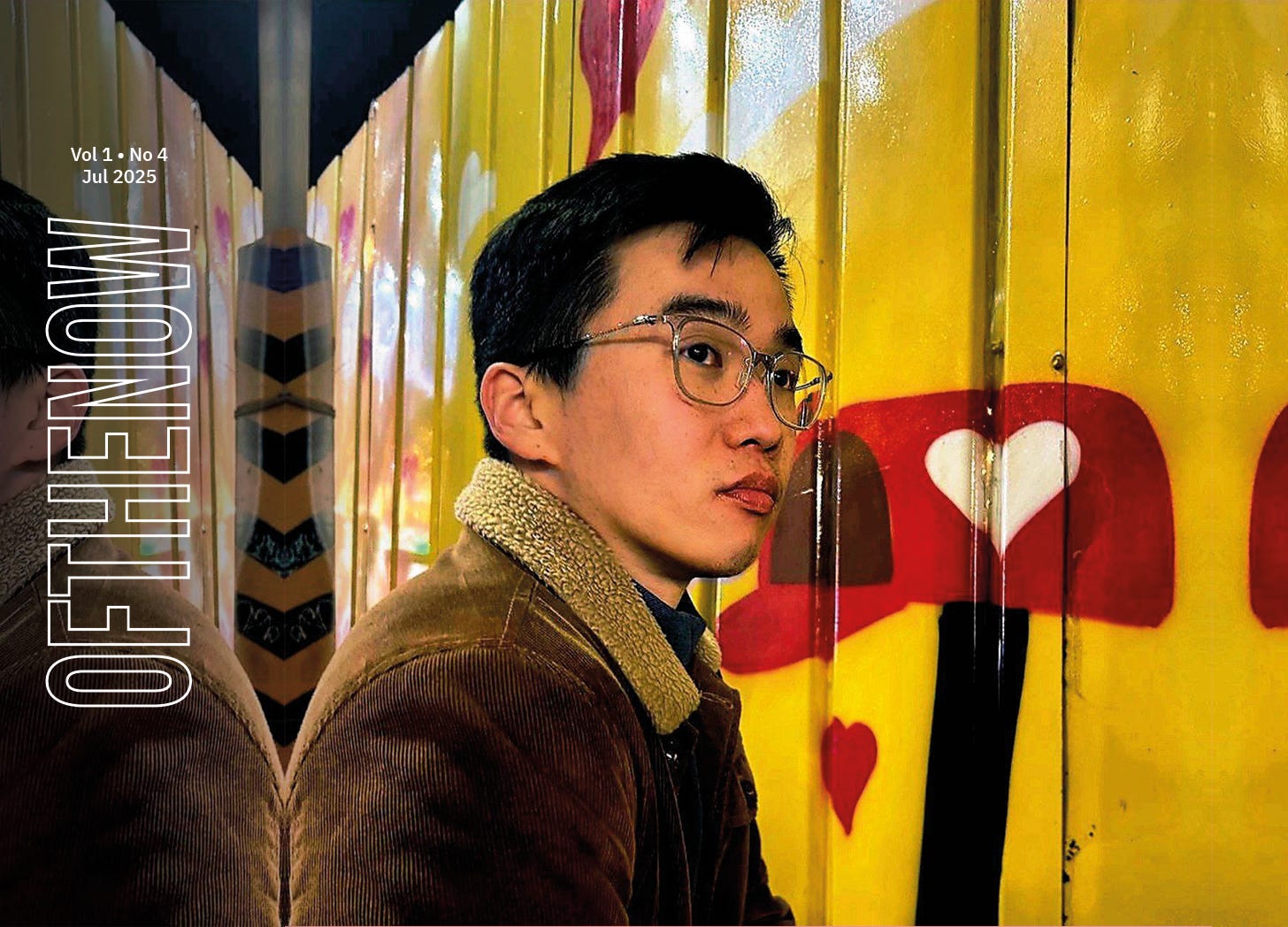
Valen Lim (b. 1995) is a writer, creative and spoken word performer. His poems have appeared in Cordite, OF ZOOS, the Straits Times, and elsewhere.
His poem in OFTHENOW Vol 1 No 4 (Jul 2025) is: “Performance Poem”.
