

to stem the bleeding: OFTHENOW Vol 1 No 11 (Mar 2026)
feat. three poems by Amanda Ruiqing Flynn; a conversation between author David Wong Hsien Ming and poet-performer-arts organiser Stephanie Dogfoot; and The Miss Mess Award For Sign of the Times

📌 MISS MESS’S BULLETIN BOARD
Hello darlings—Miss Mess has been cooking up some chaos. The month of March looks like a scene from a very dramatic dinner party thrown by someone hopped up on kopi and $14 pinot noir from Sheng Shiong (don’t judge 😔). Plates are clinking, candles are slightly crooked, and notifications are tumbling in with stories for our poor bellies. Pull up a chair or stand in one corner, Miss Thang—this table is definitely full.
First course: Hot Girls Have Stomach Issues, the debut collection by Kimberley Chia Qin. Yep, this is an ✨ exclusive teaser ✨ for OFTHENOW subscribers. Think a dining table laid out with cut fruit, kueh and the ghosts of all the conversations you’ve ever—and never—had. These poems offer a feast of the tender cuts of the human condition; first as a way to live with yourself, then eventually, as a way to thrive. My girl Kim definitely ate with this one. Whether you’re sad, or hot, or identify as neither, we’ve all got a hot girl with stomach issues inside us. More details will be dropping real soon on our Instagram!!
And the next course is another exclusive for OFTHENOW subscribers. We’re celebrating our first anniversary! 🫶 To commemorate, we’re bringing to the table Kimberley and Shreya Davies (writer of To the Last Gram) to record their OFTHENOW convo LIVE AT SING LIT STATION! Taking place on 12 April, 3pm, with coffee, snacks and books for sale, Kim and Shreya will be exploring their craft, girlhood and the complicated relationships we have with just being. RSVP via this form here! 💗
And for dessert, darlings, we’re celebrating! 🩸blood/work: ALLTHETIME 02 🩸 launched and immediately made its mark on the bestseller list! To everyone who bought a copy, came to the launch (or just screamed about it online): you made this happen. In case you missed it, blood/work is available on our webstore. Aaand if you’re hungry for more, why not go full Miss Mess and get the ALLTHETIME bundle, including rib/cage AND blood/work. Grab your books and join the feast.
Okay, so, like, what the hell? What’s going on? Send us straight into a food coma please, cos it’s the Ramadan Year of the Fire Horse-cum-30th Anniversary of Pokemon galloping straight into the eve of WW3 and Miss Moi just wants to know: is there is crack in the air?? The team has assessed all the rightful and worthy candidates for 🏆The Miss Mess Award for (Best) Sign of the (End) Times🏆—THAT BAK KWA LADY WITH THE SHOP ON FIRE + NOVITA LAM + THIS SUPER DU LAN SPEAKER OF THE HOUSE INTERJECTION + MULTIPLE OARFISH SIGHTINGS + THE RARE BLOOD MOON / TOTAL LUNAR ECLIPSE + THE RAT THAT FELL INTO SOUP AT LUCKY PLAZA—and decided to award it to: 🏆THAT GALLOPING WHITE HORSE IN PASIR RIS🏆 Because we love a biblical omen. Yes, we do! Uhuh.
Eat well. Read poetry. And remember: support women’s rights. (And women’s wrongs.)
Your sin and your symbol,
Miss Mess
Official Spokesperson, AFTERIMAGE
P.S. There are still two weeks left to our FY25 fundraising campaign! Make a kind contribution and we’ll guarantee safety for your firstborns, xoxo
🎙 LITERALLY, NO ONE ASKED BUT…

…poetry is kind of an argument? Recorded over Zoom, our final issue of OFTHENOW Vol 1 comes to a befitting conclusion with two poets reckoning with endings: David Wong Hsien Ming, co-author of blood/work: ALLTHETIME 02, and Stephanie “Dogfoot” Chan, the poet-performer-arts organiser extraordinaire who will be releasing their newest title, Please Stop Screaming, It’s Fine, later this year in the US. Touching on matters re: the art of reading poems out loud, the function of cynicism, and, well, death, their conversation has been condensed and edited for length and clarity, with its latter half made exclusive to AFTERIMAGE donors and OFTHENOW paid subscribers.
DAVID WONG HSIEN MING I guess a practical way to start this conversation would be to talk about the journey your manuscript has been on. How has finding a publisher been like for Please Stop Screaming, It’s Fine?
STEPHANIE DOGFOOT I’ve had a list of publishers that I wanted to send it to. AFTERIMAGE was one of them. It just so happened that this publisher, Game Over Books, had a call out for manuscripts that made me think, you know what, I’ll send it, and then I’ll just send it to as many other places as possible, and it just so happened so that their submissions window was during a time when AFTERIMAGE was not accepting manuscripts.
Game Over Books is a Boston-based indie press, and I heard about them because when I went to the US in 2019 for a poetry tour to promote my other book, Roadkill for Beginners, I went to a poetry slam in Portland and just started following the organisers online, and I found out one of the hosts of the slam had a chapbook published with Game Over, whose titles seemed to indicate that they were very open to publishing spoken word. Obviously, there will be challenges in publishing with a small press overseas, but I do like their principles. They are a very small team and I like that they are very solid and very passionate about what they do.
DWHM Because you mentioned they were publishing spoken word—it doesn’t matter to me, to be honest, but was that a concern for you at any point?
SD Honestly, I’d say that most of it is actually not spoken word. I don’t really see a huge difference or binary between spoken word and not. I’d say I didn’t even start out as a spoken word poet; I started properly writing in an advanced poetry workshop in undergrad, where I was writing I guess what we would call “page” poetry, for publication and journals. I just sort of discovered poetry slams the following summer and found it a much richer community than, um, writing alone in a room and sending it to like, five people in my workshop. Spoken word became a medium that I liked, but, as the years have gone on, I see my poems as working as poems on the page.
DWHM This might be the wrong instinct, but as I was working through 40-plus poems in the manuscript, I was wondering if all that experience and all that time, you know, developing the routines that you have on the stage, and what it feels to speak with people within the context of spoken word, might have had an influence on the poems here. In the sense that there are certain lines and certain moments, and if we really want to fixate on this, a couple of your endings too, where you have a declarative tone and an insistence on plain speak.
SD That was definitely influenced by spoken word, and maybe even Singapore Poetry Writing Month as well.
DWHM How so?
SD A lot of the poems in Please Stop Screaming, It’s Fine were also written during SingPoWriMo. And to an extent, with all due respect, you are writing for likes at some point during the writing challenge, which is also a criticism that’s also reserved for spoken word? And maybe because I do write for spoken word and SingPoWriMo, a lot of my work is written for an audience. Some people may describe them as populist, even. So maybe some of my poems do want to end, you know, in an easily digestible format. That’s my first instinct.
DWHM I guess what’s fortunate about some of the subject matter in Please Stop Screaming— “fortunate” being a very perverse way to put it, given how grief is a subject—is that there’s nothing populist about it. To some degree, it is what it is, and you unpack the angles, right?
SD I think part of my practice also entails being accessible. I want my poems to be the kind of thing that random people who’d hate poetry pick up, and when they read or hear my stuff, they go, okay, maybe I like it after all.
DWHM (laughs) Oh no, yeah, I don’t—I don’t know if I can say the same for myself. I hope, and I wonder, however, if the opposite could happen. Some people could pick up certain bits of blood/work, do some close reading and say, oh no, I hate poetry more now.
I mean, I guess I kind of flip between both, right? Between you and me, there was a tiny section in the third part of your book where you’ve got a couple of poems, like “Poodle”, “When the World Ends You will be Eating Canned Vienna Sausages”, “I spent 3 months in the ICU waiting room and all I got was this lousy green sticker” that’s actually quite different? The figures are different, the voices are different, the landscapes are different. But what’s common in each poem there is some degree of clean declarative speech that recontextualizes the rest of the poem? That grounds and solidifies its themes? I think that’s something I’m interested in.
SD I wonder what your relationship with accessibility is like.
DWHM When blood/work launched, I did think of reading a poem that has to some degree gotten some traction, a poem called “Chemo” that was part of Sing Lit Station’s Singapore Poetry on the Sidewalks project. There are lines in that poem that are very accessible, to the point where it almost works like advertisement copy, if you want to be cynical about that kind of thing.
But I decided to read another poem called “Circles”, which I don’t think is wholly inaccessible, but I don’t really know how effective that poem is read to an audience over being read on the page. So if I were to be a bit naval gazy and unpack that, there are word choices we tend to make, like when I’m reading Please Stop Screaming or Roadkill, that just brings a bit of a smile or a chuckle that made me think, oh, did Steph do that on purpose? Because for me, if I say something like “deadness” over the word “dead”—that’s my love for, like, clumsiness, and stupid-sounding word forms, mixed in with the complexity of the concepts or themes that I like exploring, whether it’s philosophical or metaphysical. That’s my answer to the question of accessibility, which, at the end of the day, I don’t see much misalignment with you.
SD It is interesting because, the more I think about it, a lot of poems contain a want to be understood, and there is an instinct to be very clear in what it’s about. And again, it’s an impulse that comes from spoken word, for sure, in which you only have three minutes to get your message across, and sometimes emphasise your point to people who may not be listening.
DWHM I guess that kind of brings us to a discussion on what poetry is or can be or should be. I mean, I don’t think “should” is that dirty a word, it’s probably something that we should navigate carefully, but, as you said, we have an obligation to be clear about things sometimes.
In my line of work as a teacher, the associated idea would be that of argumentation in writing, or that all writing should be an argument, and as a very unschooled version of a writer or a craftsman, you know—I wasn’t a lit grad, I dropped it quite early in my life—
SD Neither was I.
DWHM Oh! I had no idea.
SD Yeah. Wait, what did you think I studied?
DWHM I mean, I don’t wanna make assumptions, but I felt like you had some sustained engagement with literature at least before the undergrad level. So at least right up a little high school, maybe.
SD Hmm, I did take Lit for “O”-Levels, if that counts. And I was in the science stream in junior college, but I got retained, because I failed all the science classes.
DWHM Did you switch over to humanities after that?
SD For six months.
DWHM So did you do Lit in JC in the end?
SD No, because I left it. I left JC for undergrad in the US.
DWHM Right… so we have very similar trajectories. I mean, in secondary school, they assigned The House of Sixty Fathers, and it just broke me. I just wasn’t prepared for like—it’s not an intergenerational epic, but it is an intergenerational drama, and if you’re, like, 14, you just weren’t in the mood.
SD Yeah. I was actually very uninterested in Literature classes. I remember signing up for them and then dropping them last minute in undergrad, because I could have done electives, you know. But the closest I came to really studying poetry was actually in a class on religion. It’s honestly still one of the best classes I ever attended that sort of accidentally became a poetry class.
DWHM Did that class draw you back into poetry? Or was it your discovery of spoken word that did the trick?
SD I think the real beginning for me was an undergrad creative writing course I did just to fulfil an elective, and the teacher liked my poetry enough to recommend me for the advanced writing course I mentioned earlier. Even though I was, you know, a biology and environmental studies major.
DWHM Holy shit.
SD Yeah.
DWHM I just assumed you studied Law, because that’s what you do now.
SD No, Law came later. Anyway, yes, I only discovered poetry slams after I did the advanced writing course, where I kind of got the rigour of writing and editing, which definitely helped me be more rigorous in how I wrote for spoken word. But before all that, I had very, very little experience in writing and studying literature, no experience in performance whatsoever.
DWHM I don’t know if that has a bearing on what poetry is, or whether poetry can even be considered an argument, but I was studying Philosphy as an undergrad.
SD I assumed that you were an English / Literature major.
DWHM Really! No, man. The two of us are, in some sort of way, much more alike than we realise.
SD Are you teaching English now?
DWHM No, and I probably never will. I greatly enjoy watching people teach Lit, but I’m a little bit mortified whenever I watch a Lit lesson.
SD What do you teach then?
DWHM General Paper, and a philosophy subject called Knowledge and Inquiry, which is essentially epistemology. And in these disciplines, the writing is argument-driven, right, and it comes with questions like, what is the premise, what are some of the clauses in the argument. Coming from that kind of background, I just remember folks like Carol Chan saying, like, you’re giving me plot, or you’re giving me the argument of a plot, or you’re giving me what the plot argues. Not that that isn’t poetry—but is that good poetry? I wouldn’t say I wrestle with this, but it’s something I kind of still think of, because I guess it’s our job to figure things out, right? Because it isn’t always not an argument.
SD I would say like, honestly, for many years, I thought of poetry as an argument.
DWHM (laughs)
SD I used to want to tell people that I was a poet and I was a lawyer because poetry is basically arguments, but: it’s really spoken word, it’s really slam poetry, that is an argument. Not say all of it, necessarily—but a specific kind of spoken word and slam poetry is an argument.
DWHM Does spoken word have to be an argument? And when it isn’t, what do you see it as?
SD I think a lot of people’s first experience of spoken word is an argument? If you go into, like, American slam—I don’t know how much you know about American slam culture—but it’s a competition, basically, and it’s often very political. Sometimes it can be about political issues, sometimes it can get very personal. Very often you are using your own experiences to argue a political point, or a point of view? In that sense, it basically is like an argument, in which you’re pulling out all the things that you can use to make your point and make your argument.
But that is just one example. There’s many other forms of spoken word, like in the UK, where you have a totally different history of spoken word and performance poetry, where there’s a school of thought that sort of comes from punk music that gave rise to the punk poets of the 70s and 80s. Some of it was very, very political, obviously. Some of it also had a lot in common with stand-up comedy as well. A lot of it was just to make people laugh. I think there’s definitely space for it to not be an argument.
DWHM What I feel like you’re saying is that it is political, it is personal, and obviously it can be argumentative, we don’t need to surrender that aspect entirely. But if we’re going back to the idea of accessibility, or if we’re, you know, maybe a bit arrogant to make a bit of a normative argument—I guess I’ll say that what I like about your trajectory is that poetry is as much an argument as it is political exploration. Right? The goal of poetry is always to unpack, make strange, make more. That more-ness will come through in the exploration.
SD Having been exposed to a lot of the spoken word scenes in the UK and Singapore, I think my poetry, more and more, is veering away from being arguments, because that’s what I see. The scenes are saturated with this kind of work, and I think in general, a lot of spoken word poets are trying to move away from that as well.
What would you say another goal of poetry is?
DWHM Hmm. To me, the starting and sometimes the ending point of poetry is always to achieve some version of beauty. When you’re reading a poem, I want to experience not the poet’s craft, but the craft of being in the world, I guess, the process and the feeling. Appreciation might even be too small a word, so I guess the next simplest one I would use would be the experience of a certain, meaningful attention. I guess that’s why so many of us poets maybe enjoy adjacent disciplines, you know, like photography or film, or painting, or arthouse films in particular, where there’s a mystique in the way things are framed and plotted.
SD I suppose one goal is, like you said, to complicate people’s view of the world, and to give them new ways of seeing the world. Maybe even make people question their worldview. For me, that’s one thing. I think another reason why I write, or another goal of writing poetry I have, is to sort of just make sense of memories? And in a way to record them down, and record the feelings and the things that have happened and try to broadcast them.
A big thing for me is also connection. Why I do spoken word is basically to connect with people, and to help people feel seen maybe, because I like to write about very specific things that have happened, things I’ve been through, and I think what sometimes happens with people is that they will hear a poem and go, “Oh, I thought I was the only one that ever experienced that,” and then, “Oh wow, you said something that I’ve not been able to put into words.”
DWHM It’s important, then, that poetry challenges, and could even be transgressive, even when it’s fostering an active connection. That would allow a memory to hold more tension. (to be continued below)
✏️ BIG POET ENERGY
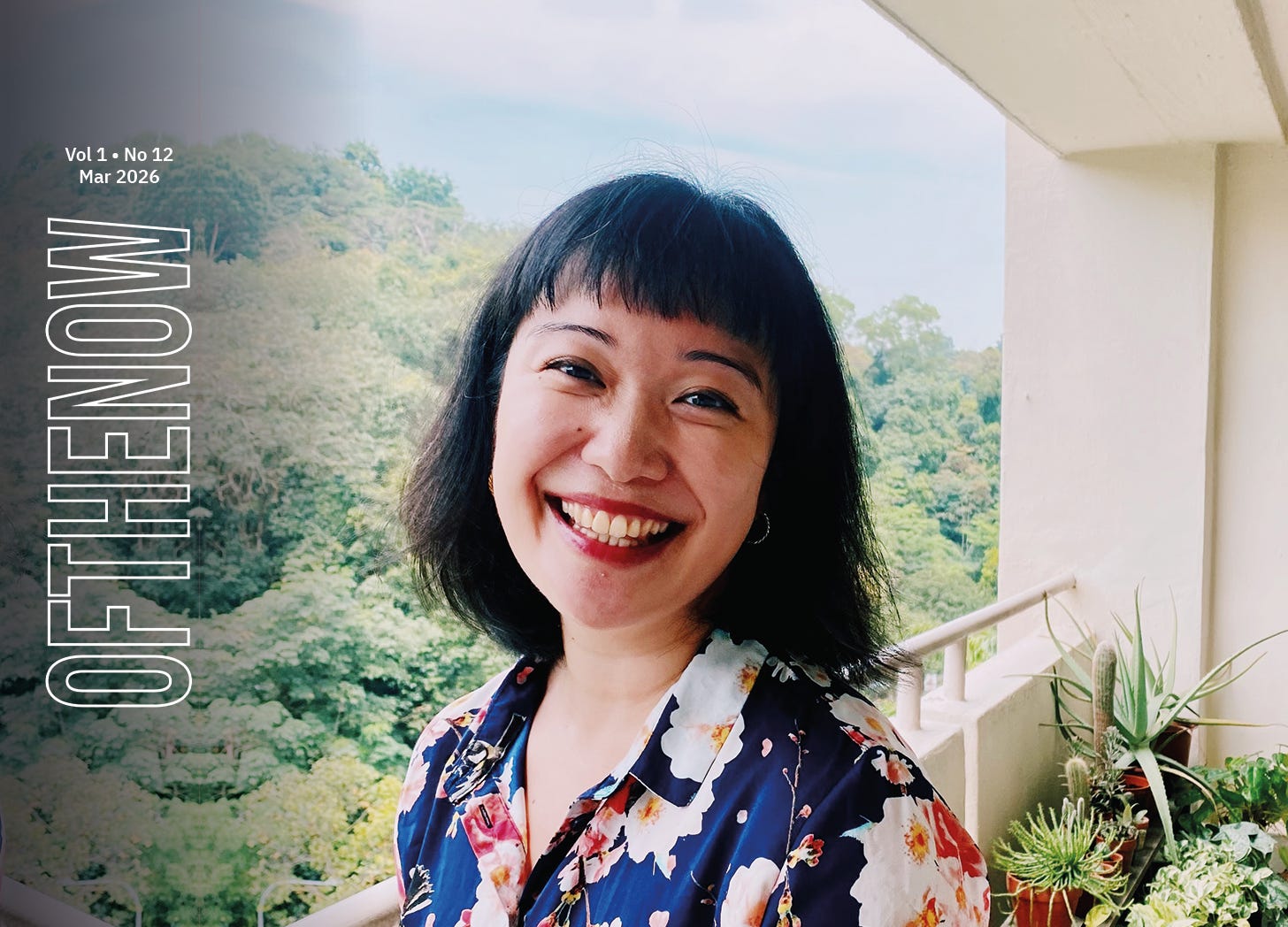
Amanda Ruiqing Flynn (b. 1988) works across words and images. She began life in a Lim Chu Kang kampung, and later lived in the UK and Taiwan. Her poetry returns to survival, love, and wonder. She received the 2025 Golden Point Award (2nd Prize) for Translation: Short Story (English). Her work continues at @amandas.paint.and.pen / amandaruiqingflynn.com.
Her poems in OFTHENOW Vol 1 No 12 (Mar 2026) are: “F.A.T Club”, “proof that god exists” and “Idle engines”.
